𝙵𝙰𝙸𝚃𝙷, 𝙰𝚄𝚃𝙷𝙾𝚁𝙸𝚃𝚈 𝙰𝙽𝙳 𝙸𝙽𝚂𝚃𝙸𝚃𝚄𝚃𝙸𝙾𝙽𝙰𝙻 𝙸𝙽𝚃𝙴𝙶𝚁𝙸𝚃𝚈

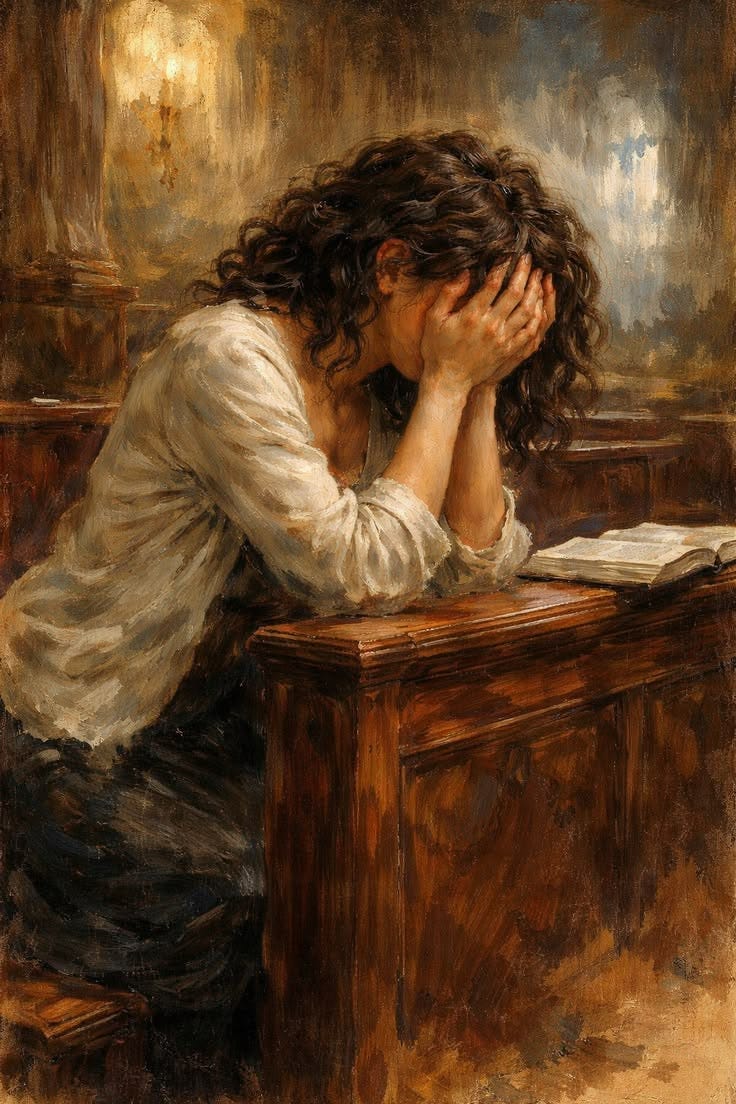
People that know me know I was raised by parents who are devoted Christians.Faith was not just something we talked about occasionally in our home, it was part of the structure of everyday life. Prayer, church, scripture, belief; it was all familiar long before I fully understood what any of it meant.
And I was a Christian too. I still am.
Growing up, belief felt simple. You’re taught that Christ listens to your prayers, that faith provides answers, that if you live according to His teachings, things eventually make sense. The end goal being eternal life. And there’s comfort in that kind of certainty. It gives you a framework for how the world works and how you’re supposed to move through it.
For most of my childhood and teenage years, I didn’t question it much. I believed the way many people do when they grow up in faith—you accept it naturally because it’s the world you were given. Church felt normal. Prayer felt normal. Even the rules and expectations that came with religion felt normal.
It wasn’t until I finished high school and joined campus that things started to shift.
Campus has a way of expanding your world whether you’re ready for it or not. You meet people with different beliefs, different experiences, different ways of interpreting life. Suddenly the things you once saw as absolute truths exist alongside a hundred other perspectives.And that’s where the questions started.
Luckily for me, I was surrounded by people who were willing to answer every one of them.
The questions I had were never really about the existence of God or Jesus. Those were never the issue for me. My questions were about the practices, about the way faith is sometimes carried out by the people who claim it.
We are taught that Christians should love everyone equally. Treat people with respect. Welcome new believers with open arms.
But I started noticing things that didn’t always match that teaching.
A close friend of mine once had questions about our faith. When he tried to ask them, he was silenced. Instead of engaging with his curiosity, he was labeled rebellious. Some even called him demented. Eventually he was taken to a pastor and prayed for, as if asking questions was something that needed to be corrected.I never forgot that moment, because questions should never be treated like a disease.
I had also heard people say that the church sometimes drives people away, but it never really made any sense to me until I saw it happen.
There was someone new to the faith.Someone trying to start a different life. Someone the church should have treated with grace.
But that wasn’t the case.
Instead, people gossiped about his past. They spoke about him as if his history made him unworthy. They criticized how he dressed, saying it didn’t “reflect the Lord”. They said listening to secular music meant he was still living in “the world.” Some even judged him for wearing necklaces. These felt like ridiculous reasons to question someone's faith.
What stood out the most was that no one seemed to recognize the effort he was making.
No one acknowledged that he was trying.
Eventually, he left.
And suddenly a phrase I had heard before started to make sense in a way it never had before: there’s no hate like Christian love.
Some might say those were just people who drove him away, not the church itself.But the church is made up of people and the people are the church.
As I continued observing different spaces within Christianity, I began noticing other things that troubled me.
Some believers seemed to measure someone’s faith based on how long they prayed. Prayer started looking less like a sincere conversation with God and more like something performative, as if the length of your prayer somehow proved how spiritual you were.
I also began noticing how different denominations often seemed to operate almost like competitors, each claiming to be the “right” church or the “true” church.
Some preachers even went as far as declaring that other churches were not truly Christian, despite practicing many of the same things.
It made me wonder why faith sometimes looked more like rivalry than unity.
Another thing that troubled me was the way some believers judged others for sins they themselves did not commit while quietly ignoring their own. Certain sins were condemned loudly, while others were conveniently overlooked. Instead of extending grace to one another, people often seemed quicker to condemn.
And when someone fell short, as all human beings inevitably do, they were pushed further away instead of being supported and loved.
That contradiction never sat well with me.
Because if Christianity teaches that everyone is a sinner and that grace is central to the faith, then grace should also exist within the community of believers. Yet too often, judgment appeared faster than compassion.
Even more troubling were the moments where pastors were treated as if they were beyond accountability.
I’ve seen situations where so-called men of God got away with serious wrongdoing simply because they were “anointed.” As if that label alone placed them above questioning or criticism.
I remember hearing about a case where a girl was assaulted by a pastor. Instead of the church standing by her, many members chose to defend the pastor. The assumption was that the pastor could not possibly be wrong because he was chosen by God. That kind of thinking is very dangerous
I’ve also seen churches where congregants were pressured financially in ways that felt deeply uncomfortable. There have been cases where pastors closed church doors until members contributed a certain amount, or constantly urged people to give large portions of their wealth with the promise that God would bless them in return.
At some point, I started asking myself a difficult question.
Is the church preaching the word of God, or has it in some places become a business and a platform for influence and politics?
Another teaching that never sat right with me was the idea that pastors should never be questioned. I once heard a preacher say that questioning a pastor is wrong because they are anointed by God, and that believers should follow what they say without doubt.
But that idea feels deeply troubling.Because history has shown us what happens when people in positions of authority are placed beyond questioning.
Faith should not require blind obedience to human leaders.
Despite all these observations and questions, my faith itself never disappeared. If anything, it forced me to separate two things that are often treated as the same: God, and the institutions built around Him.
Because faith and belief, at their core, should not be about control, power, judgment, or performance. They should be about compassion, humility, honesty, and grace.
But blind faith and hypocrisy are often what corrupt the very spaces meant to nurture belief.
When questioning is discouraged, when leaders are placed beyond accountability, when judgment replaces grace, and when power becomes more important than people, something has clearly gone wrong.
Faith should never be used as a shield for wrongdoing.
It should never silence victims, excuse abuse, or protect those in positions of authority from being held accountable. And it should never be used to measure, shame, or push people further away when they are already struggling.
The problem is not that people are asking questions.
The problem is that too many institutions built around faith have made it an enterprise rather than a place of worship.
When that happens, the focus turns from service to status, from humility to hierarchy, and from truth to image.
Because when harmful practices continue under the guise of faith, it does not protect religion, it weakens it.
And perhaps the real challenge for any faith community is not convincing people to believe.
It is being willing to confront the things happening within its own walls.
Every man exists with his own hypocrisy something religion refuses to acknowledge completely hence it's just a constant performative culture to see who is " most religious " this is why holding the institution itself is near impossible
Change of a community starts with one person yes but kidogo the one person's light is trampled on. That's why you'll notice kama msee alikuwa a leader somewhere in the church, anakataa kutake the position after serving his or her term.